
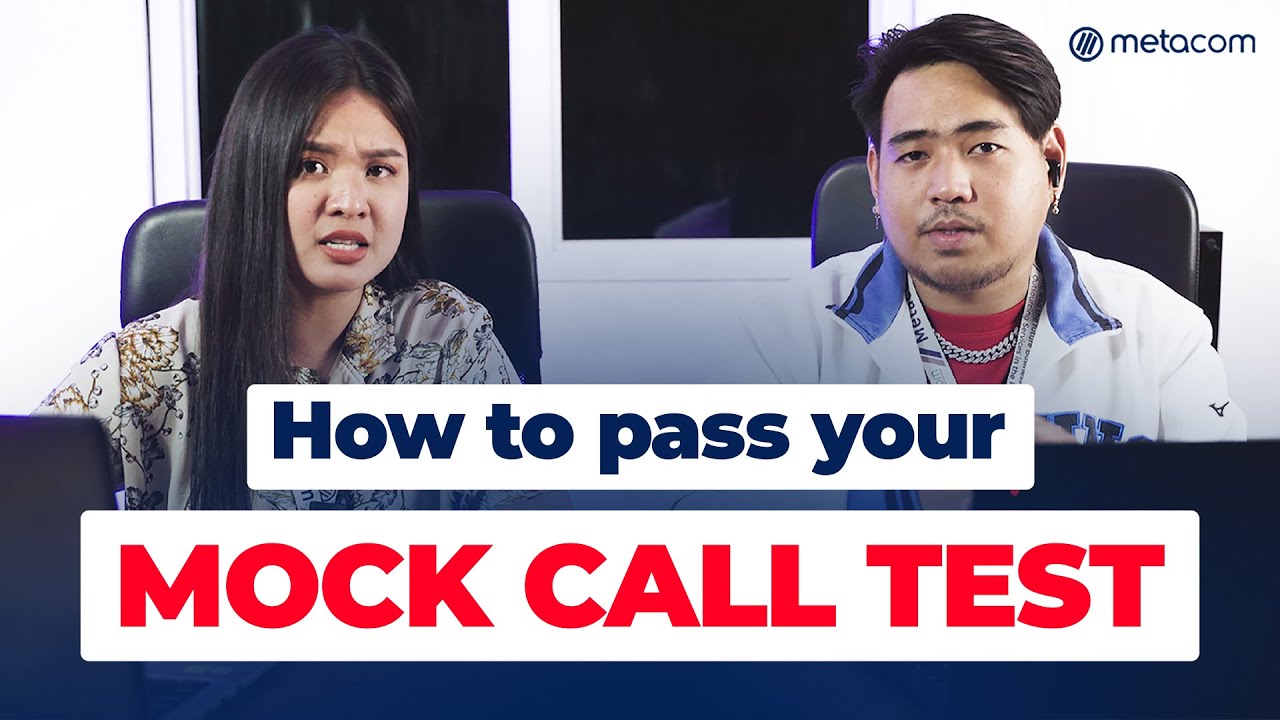
BPO Mock Call Guide and Sample
Preparing for a BPO interview often involves more than answering standard interview questions. A Mock Call is one of the most common assessments used to evaluate how applicants communicate with customers, handle concerns, and follow a basic call flow.
A Mock Call allows recruiters to assess your communication skills, active listening, empathy, problem-solving ability, confidence, and ability to handle a realistic customer interaction.
Whether you are a fresh graduate, career shifter, or experienced applicant, understanding the basic call flow can help you prepare for your BPO interview and perform with greater confidence.
Watch the Full Mock Call Video
Learn more about the basic call flow and see a Mock Call example in action through the Metacom Careers video below.
What Is a Mock Call?
A Mock Call is a simulated customer service conversation used during the BPO hiring process to assess how applicants communicate and handle different customer situations.
During a Mock Call, the recruiter or interviewer may act as the customer while you take the role of the customer service representative.
You may be given a scenario involving:
- A delayed order
- A billing concern
- A product or service inquiry
- An account issue
- A technical concern
- A request for assistance
The goal is not simply to provide the correct answer. Recruiters also want to see how you communicate, listen, ask questions, show empathy, and guide the customer toward a resolution.
What Is the Basic Call Flow?
A typical BPO call follows a structured process. While the exact procedure can vary depending on the company and account, understanding the basic call flow can help you stay organized during a Mock Call.
A simple call flow includes:
- Opening the call
- Listening to the customer
- Showing empathy
- Asking clarifying questions
- Providing a resolution
- Confirming the resolution
- Closing the call
Let's look at each step.
1. Opening the Call
The opening creates the customer's first impression of the representative.
Start with a professional greeting and introduce yourself.
For example:
"Thank you for calling customer support. My name is Alex. How may I assist you today?"
Speak clearly and confidently. Avoid sounding rushed or as if you are simply memorizing a script.
A good opening should be:
- Professional
- Clear
- Friendly
- Concise
- Confident
During a Mock Call, your opening can immediately demonstrate your communication skills.
2. Listen to the Customer
After opening the call, allow the customer to explain the concern.
One common mistake applicants make during a Mock Call is interrupting too quickly.
Practice active listening by:
- Allowing the customer to finish speaking
- Paying attention to important details
- Avoiding unnecessary interruptions
- Taking note of the customer's main concern
- Asking relevant follow-up questions
You should understand the problem before attempting to provide a solution.
3. Show Empathy
Customers want to feel heard and understood.
After listening to the concern, acknowledge the customer's situation.
For example:
"I understand how frustrating it can be to experience a delay with your order. I'll be happy to check what happened and see how we can resolve this for you."
Empathy does not mean admitting fault when you do not have enough information. It means recognizing the customer's concern and showing that you are willing to help.
Useful empathy statements include:
- "I understand how frustrating that can be."
- "I can certainly understand your concern."
- "I'm sorry you're experiencing this issue."
- "I understand why you would want this resolved as soon as possible."
4. Ask Clarifying Questions
Once you understand the general concern, ask questions that will help you identify the issue.
For example:
"May I have your order number so I can check the status of your order?"
Depending on the situation, you may need to ask for:
- Account information
- Order number
- Transaction details
- Product information
- Dates or reference numbers
- Specific details about the problem
Avoid asking unnecessary questions. Focus on information that will help you resolve the concern.
5. Provide a Resolution
After gathering the necessary information, explain what you can do to help.
For example:
"I've checked your order, and it appears that there was a delay during shipping. The updated delivery date is Friday. I can also document your concern so the issue can be properly monitored."
When providing a resolution:
- Be clear
- Be specific
- Explain the next steps
- Avoid unnecessary technical language
- Do not make promises you cannot keep
If you do not know the answer during a Mock Call, do not panic.
You can use a professional response such as:
"Let me verify that information for you so I can provide you with the most accurate answer."
This is better than guessing.
6. Confirm the Resolution
Before ending the interaction, make sure the customer's concern has been addressed.
You can ask:
"Does this resolve your concern today?"
Or:
"Is there anything else I can assist you with regarding this concern?"
This step demonstrates that you are focused on customer satisfaction and that you are not simply trying to end the call quickly.
7. Close the Call
Once the customer's concern has been addressed, end the call professionally.
For example:
"I'm glad I was able to assist you today. Thank you for calling customer support. Have a great day!"
A professional closing should leave the customer with a positive impression.
Mock Call Sample
Here is a simple example of how a Mock Call may sound.
Scenario: Delayed Order
Customer:
"Hi, I'm calling because my order was supposed to arrive yesterday, but I still haven't received it."
Applicant:
"Thank you for letting me know. I understand how frustrating it can be when an order doesn't arrive as expected. I'll be happy to check the status of your order. May I have your order number, please?"
Customer:
"Sure. It's 123456."
Applicant:
"Thank you. Please allow me a moment while I check that information."
Applicant:
"Thank you for waiting. I've checked the order, and it appears that there has been a delay in shipping. The updated delivery date is Friday."
Customer:
"Okay. Is there anything else I need to do?"
Applicant:
"No additional action is required from you at this time. Your order is already in transit, and the updated delivery date is Friday. Does this resolve your concern today?"
Customer:
"Yes, thank you."
Applicant:
"You're welcome. I'm glad I was able to assist you. Thank you for calling, and have a great day!"
This example demonstrates a basic call flow:
Opening → Listening → Empathy → Verification → Resolution → Confirmation → Closing
What Do Recruiters Look for During a Mock Call?
Recruiters are not necessarily looking for applicants who sound like professional call center agents from day one.
Instead, they may evaluate your potential and how well you demonstrate important customer service skills.
Communication Skills
Can you communicate your thoughts clearly and professionally?
Your answers should be understandable without being overly complicated.
Active Listening
Do you listen to the customer's concern before responding?
Strong active listening helps prevent misunderstandings and unnecessary questions.
Empathy
Can you acknowledge the customer's feelings while remaining professional?
Empathy can help create a better customer experience.
Problem-Solving
Can you identify the customer's concern and determine an appropriate next step?
Even when you do not immediately know the answer, recruiters want to see how you approach the problem.
Confidence
Confidence is important during a Mock Call.
You do not need to sound perfect. Focus on speaking clearly, maintaining a professional tone, and avoiding unnecessary hesitation.
Call Control
A customer service representative needs to guide the conversation while still allowing the customer to explain the concern.
Good call control means keeping the conversation focused and moving it toward a resolution.
Common Mock Call Mistakes to Avoid
Even experienced applicants can make mistakes during a Mock Call.
Here are some common issues to watch out for.
1. Speaking Too Fast
Nervous applicants may speak quickly without realizing it.
Slow down and focus on speaking clearly.
2. Interrupting the Customer
Allow the customer to finish explaining the concern before responding.
3. Sounding Like You Are Reading a Script
A script can help you understand the call flow, but avoid sounding robotic.
Use the structure as a guide rather than memorizing every word.
4. Forgetting Empathy
Going directly into troubleshooting without acknowledging the customer's concern can make the interaction feel cold.
5. Guessing the Answer
If you don't know something, don't invent an answer.
Instead, explain that you will verify the information.
6. Ending the Call Too Quickly
Before closing the call, confirm whether the customer's concern has been addressed.
7. Losing Confidence After Making a Mistake
Making a small mistake does not automatically mean you failed the Mock Call.
Recover professionally, continue the conversation, and focus on the next step.
How to Prepare for a Mock Call
Preparation can help reduce nervousness and improve your performance.
Practice Common Customer Scenarios
Practice situations such as:
- Billing concerns
- Delayed orders
- Account issues
- Product inquiries
- Refund requests
- Technical problems
- Service complaints
Practice Your Opening and Closing
You don't need to memorize an entire conversation.
Instead, become comfortable with your basic opening and closing statements.
Improve Your Active Listening
Practice listening to a question completely before responding.
Practice Speaking Clearly
Record yourself answering sample customer questions and listen to your tone, pacing, and pronunciation.
Learn Basic Customer Service Expressions
Useful phrases can help you sound more professional.
Examples include:
- "I'd be happy to assist you with that."
- "Let me check that information for you."
- "Thank you for your patience."
- "I understand your concern."
- "Let me see what options are available."
- "Is there anything else I can assist you with today?"
Focus on the Process
Don't worry about creating the perfect answer for every possible scenario.
Focus on understanding the basic call flow and adapting it to the situation.
Do You Need Perfect English for a Mock Call?
You do not necessarily need perfect English to perform well in a Mock Call.
What matters is your ability to communicate clearly and professionally.
Focus on:
- Clear pronunciation
- Proper sentence construction
- Appropriate vocabulary
- Active listening
- Professional tone
- Confidence
Avoid using overly complicated words simply to sound impressive.
Simple, clear, and professional communication is often more effective.
Mock Call Cheat Sheet
Use this basic structure when practicing before your BPO interview.
| Call Flow | What to Do | Example |
|---|---|---|
| Opening | Greet and introduce yourself | "Thank you for calling. My name is Alex. How may I assist you?" |
| Listen | Understand the concern | Allow the customer to explain |
| Empathy | Acknowledge the concern | "I understand how frustrating that can be." |
| Clarify | Ask relevant questions | "May I have your order number?" |
| Resolve | Explain the solution | "I've checked the account and here's what we can do." |
| Confirm | Make sure the concern is addressed | "Does this resolve your concern today?" |
| Close | End professionally | "Thank you for calling. Have a great day!" |
Frequently Asked Questions About Mock Calls
What is a Mock Call?
A Mock Call is a simulated customer service conversation used during the BPO recruitment process. It helps recruiters evaluate communication, listening, empathy, problem-solving, confidence, and customer service skills.
What should I say during a Mock Call?
Follow a basic call flow: greet the customer, listen to the concern, show empathy, ask clarifying questions, provide a resolution, confirm the solution, and close the call professionally.
Do I need to memorize a Mock Call script?
No. It is better to understand the basic call flow rather than memorize an entire script. This allows you to sound more natural and adapt to different customer situations.
What should I do if I don't know the answer?
Do not guess. Let the customer know that you will verify the information and provide the most accurate answer possible.
For example:
"Let me verify that information for you so I can provide you with the most accurate answer."
How can I sound more confident during a Mock Call?
Speak clearly, slow down your pacing, use professional language, and focus on the customer instead of worrying about making mistakes.
Practice can also help you become more comfortable with common call scenarios.
What are recruiters looking for during a Mock Call?
Recruiters may evaluate communication skills, active listening, empathy, problem-solving, confidence, professionalism, and your ability to follow a logical call flow.
Related Resources
Want to learn more about starting and building your BPO career? Check out these helpful resources from Metacom Careers:
Watch More Career & Interview Tips
For more BPO career advice, interview tips, recruitment updates, and job-hunting guides, subscribe to the Metacom Careers YouTube channel.
Subscribe to Metacom Careers on YouTube
Start Your BPO Career With Metacom
Don't let a lack of preparation hold you back from your next BPO opportunity.
Prepare, practice, and put your best foot forward during your next interview.
Whether you're an experienced BPO professional, a fresh graduate, or a career shifter, taking time to prepare can help you make a stronger impression during the hiring process.
Now that you understand the Mock Call process and basic call flow, take the next step and explore opportunities that match your skills, experience, and career goals.
Explore Metacom Career Opportunities
Start your career journey with Metacom Careers today.